Written by an interested party. Checked against the public record.
Disclosure. The author of this report founded The 1565 Coalition and owns The Outpost @ Old Moultrie Rd, the business in this case. The Coalition is sponsored by The Outpost. We say that first so you can weigh everything that follows. Every fact below comes from County agenda packets, recorded orders and published reporting, and each is cited so you can check it without taking our word for it.
A documented fact is presented as a fact. A position is presented as a position, including ours. An analysis is labeled as our conclusion. Look for these labels:
A commercial corner, fifty years in use
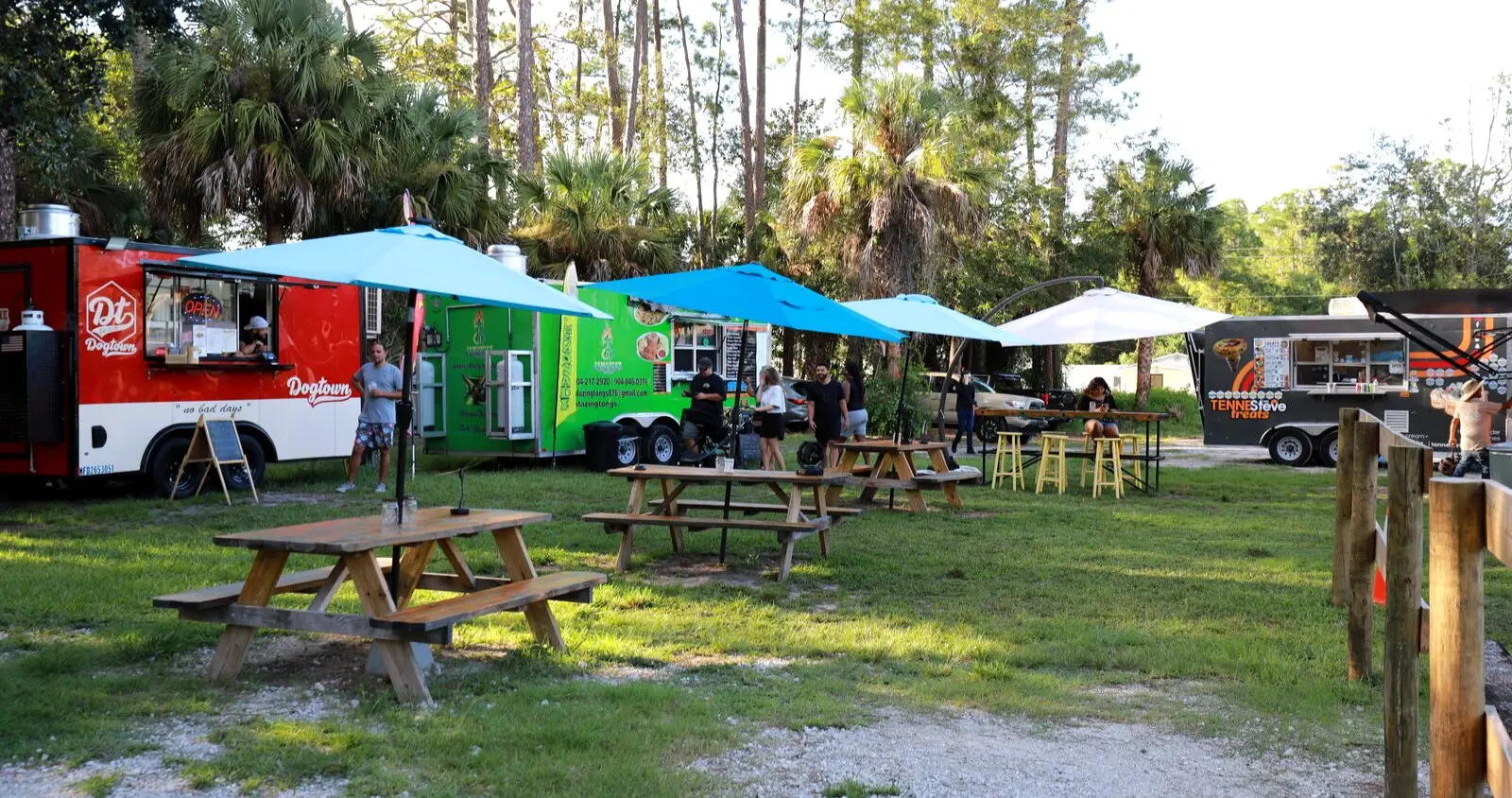
FactThe Outpost @ Old Moultrie Rd sits on about 1.8 acres at 2505 Old Moultrie Road in St. Augustine, at the corner of Old Moultrie and Lewis Point Road Extension. The parcel is zoned Commercial, Intensive (CI). It had been in commercial use for roughly fifty years, including a veterinary clinic, before the current owner bought it.[7][12]
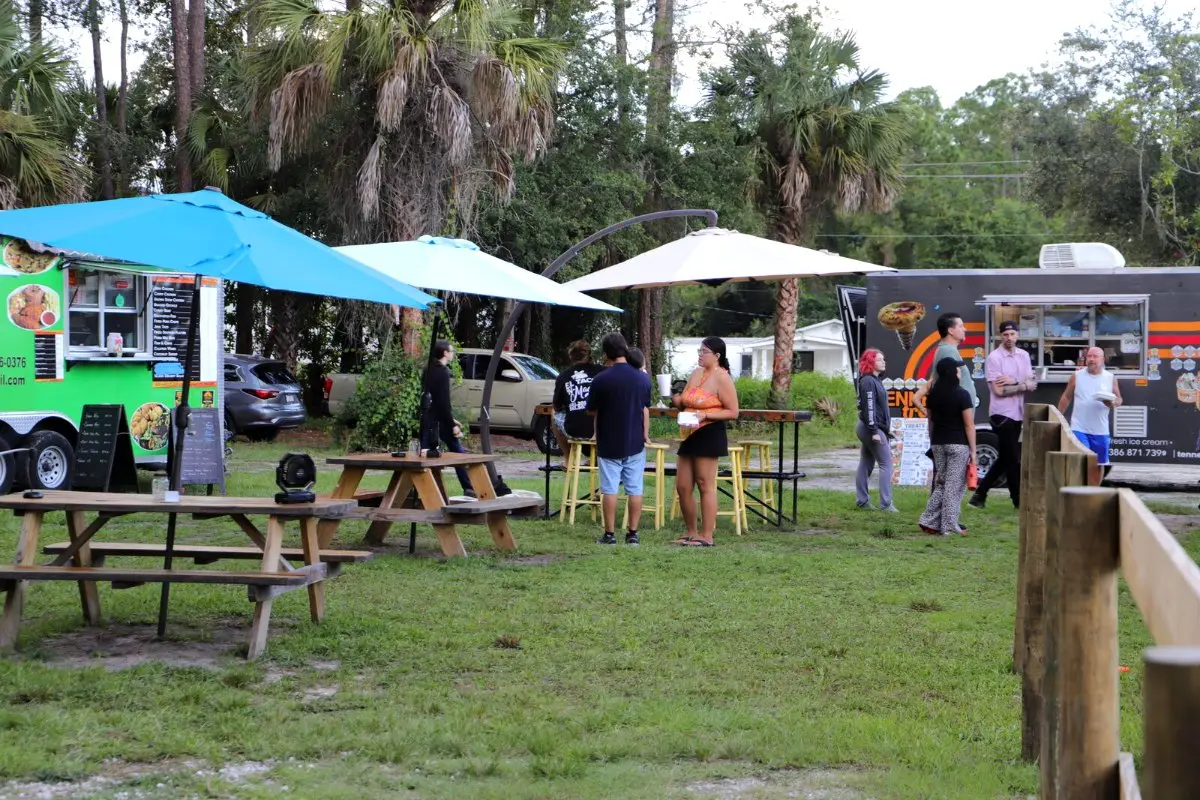
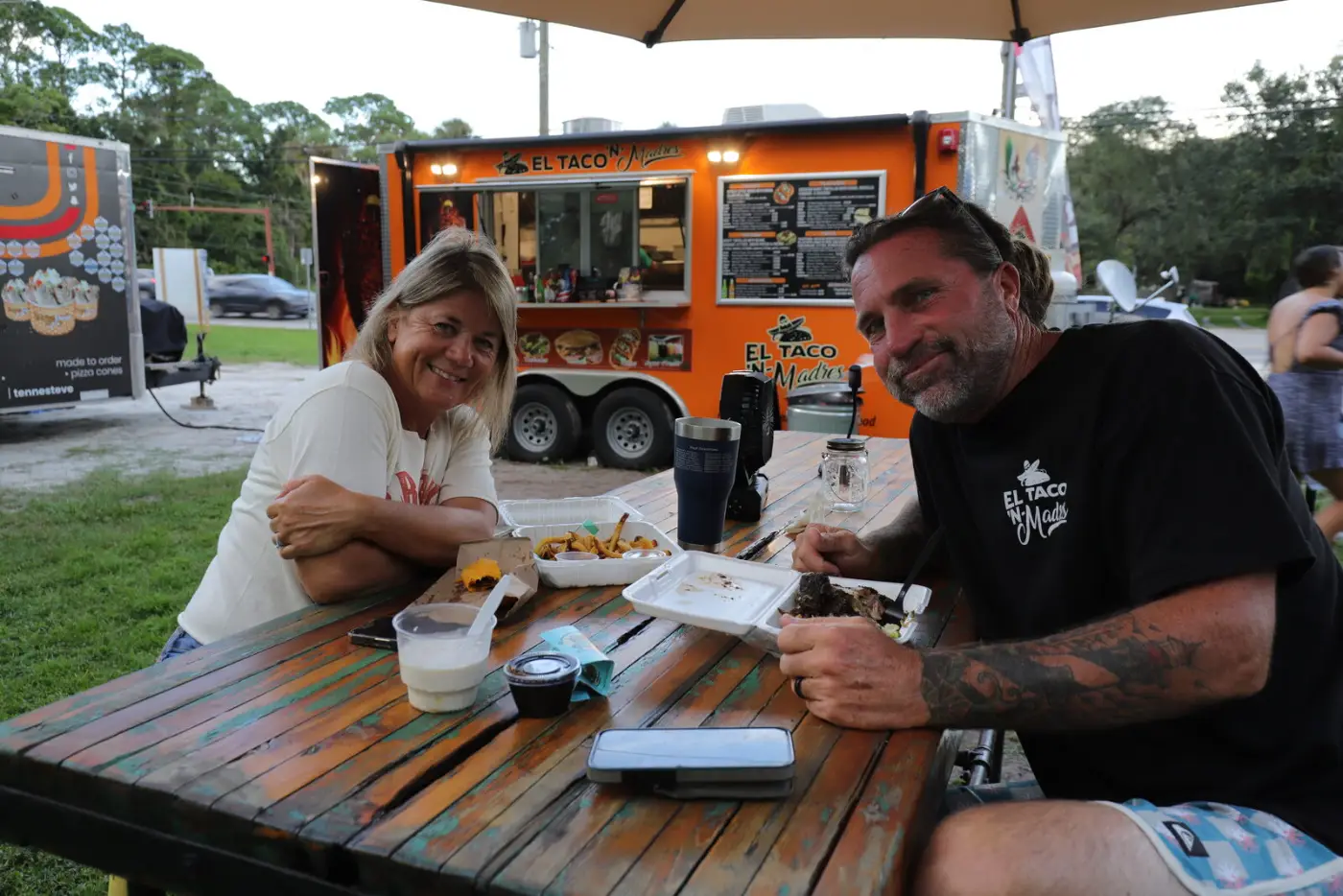
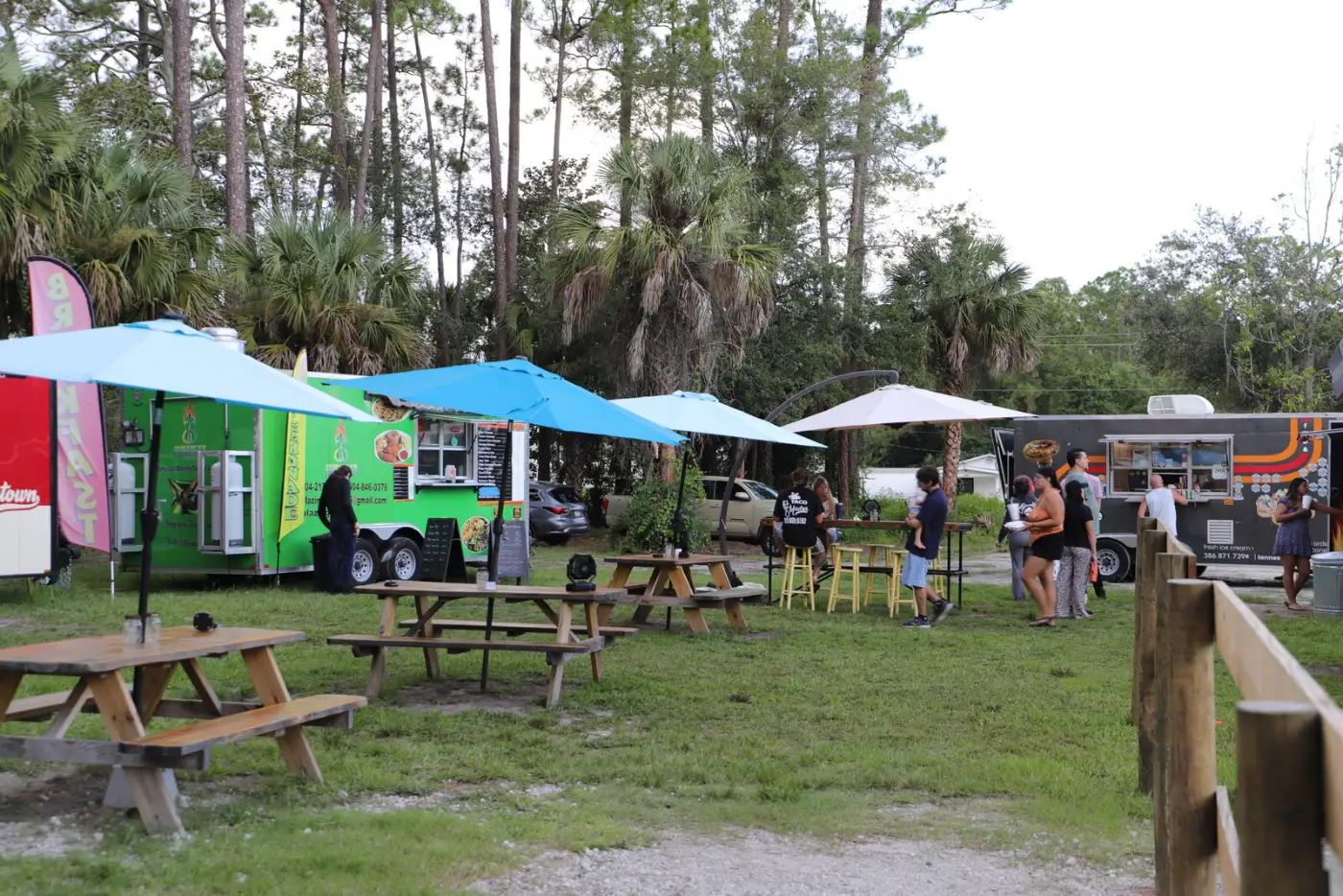
The business is a food truck park and community gathering space: a rotating group of independent food trucks, shared seating, and a place for locals to gather. By early 2026 it had a regular roster of vendors and a following.[8][9]
A use the Land Development Code didn't have
Before September 2026, the St. Johns County Land Development Code did not define a food truck, did not define a food truck park, and did not list either as a permitted use in any zoning district.
FactThe County's Land Development Code (Ordinance 1999-51, as amended) governs what can be built and operated on every commercial parcel in the unincorporated county. Until the 2026 amendment it had no definition of a food truck or a food truck park, no use category for one in any zoning district, and no design standards for one.[1][2]
FactThe State regulates the trucks themselves. A mobile food dispensing vehicle is licensed by the Florida Department of Business and Professional Regulation under section 509.102, Florida Statutes, and state law preempts local licensing and permitting of the vehicles. It does not preempt local zoning, which is where the question of where a park may operate lives.[3]
Why the gap mattered
AnalysisWhen a use is not in the Code, staff has to fit it to something that is. In this case the trucks were treated as accessory to a principal commercial building, which meant the questions became: is there a principal structure, is there paved parking, are there permanent utilities and restrooms, and does the site still count as "improved" commercial property. Reasonable people read those provisions differently. That is exactly what happened.[7][8]
FactThe parking rule shows the cost of the gap. The Code requires asphalt or concrete parking unless the use appears on a short list of uses allowed to use coquina, crushed stone or gravel (Section 6.08.42). A food truck park was not on that list, so a gravel or shell lot, the natural surface for a park of trucks, was not available by right.[1]
PositionThe owner's reading: the site had been commercial for fifty years, had utilities and access, and met the Code's broad definition of improved property; nothing in the Code clearly prohibited food trucks as an accessory use. PositionStaff's reading: once the building was demolished the site no longer qualified as a previously developed commercial site, and without paved parking, permanent utilities and restrooms it could not host the trucks.[7][12]
From a complaint to a closure order
FactIn August 2025, County planners told the owner the site could not proceed as a food truck park until it was developed as a new commercial site. In January 2026 a code enforcement case was opened (PRIDE case 2600700). By March the old building had been taken down and trucks were operating on the site. A Special Magistrate found the property out of compliance and ordered the food truck operation closed; the trucks stopped serving in late April.[4][8][9][12]
FactOn April 23 a meeting between the owner and County officials, arranged through Commissioner Ann Taylor, ended with both sides describing the Code as ambiguous and staff exploring a temporary path to reopen. The staff interpretation was appealed to the Board of County Commissioners.[12]
Timeline
- Aug. 2025County planners say the site can't proceed as a food truck park without new site development.[8]
- Jan. 29, 2026Code enforcement case 2600700 opened.[4]
- Mar.–Apr. 2026Old building demolished; trucks operating. Special Magistrate orders the operation closed. Site closes in late April.[8][12]
- Apr. 23, 2026Owner and County officials meet; both describe the Code as ambiguous.[12]
- May 5, 2026Board of County Commissioners hears the appeal. Votes 3–2 to overturn staff's interpretation. Votes 5–0 to direct staff to write food truck parks into the Code.[7]
- May 8, 2026The Outpost reopens.[8]
- May 13, 2026Notice of violation withdrawn.[4]
- July 8, 2026Special Magistrate grants an Order of Compliance; the enforcement case is resolved without a fine.[4][5]
- July 21, 2026First reading of LDCA 2026-05, Food Truck Parks.[1]
- Aug. 6, 2026Planning and Zoning Agency recommends approval unanimously, adding a noise-ordinance condition.[1][10]
- Sept. 15, 2026Board adopts Ordinance 2026-31 unanimously.[1][6][11]
"We've identified a significant gap in our land development code, and that's putting small businesses in jeopardy."
Commissioner Ann Taylor · May 5, 2026 · Photo: The OutpostMay 5: a 3–2 vote and a 5–0 vote
FactThe Land Development Code lets a property owner appeal a staff interpretation to the Board of County Commissioners. On May 5, 2026, the Board heard the Outpost's appeal in open session. Commissioners Christian Whitehurst, Ann Taylor and Sarah Arnold voted to uphold the appeal and overturn the interpretation; Commissioners Clay Murphy and Krista Joseph voted against. The park reopened that Friday.[7][8]
FactThe same day, the Board voted unanimously to direct staff to draft Code changes that would treat food truck parks as a distinct use with their own standards, including a look at whether requirements like paved parking should be reduced. The staff report for the ordinance that followed records that direction: "The Board of County Commissioners requested an update to Land Development Code regulations regarding Food Truck Parks at their regularly scheduled public hearing on Tuesday, May 5, 2026."[1][7]
For the appeal
"We have to uphold the appeal and overturn the interpretation." — Commissioner Whitehurst
"We've got to create policies that are business friendly." — Commissioner Whitehurst
Against
"You cannot come in and do work and then say … that it is now an improved site." — Commissioner Murphy
"I'm not comfortable seeing you open it tomorrow … I want to make sure everyone's safe." — Commissioner Joseph
Quotes as reported by the St. Johns Citizen and News4JAX.[7][8]
AnalysisA split vote is the honest result. Three commissioners read the Code one way and two read it the other, which is what happens when a code is silent. The more important vote was the second one. Five commissioners agreed the Code needed a food-truck-park use, and that agreement is what produced a durable answer for every operator, not just this one.
LDCA 2026-05: what the County wrote
FactGrowth Management brought a draft to the Board for a first reading on July 21. The Planning and Zoning Agency recommended approval unanimously on August 6, adding a condition that parks comply with the County's noise ordinance. The Board adopted the amendment unanimously on September 15, 2026, as Ordinance 2026-31. It takes effect when a certified copy is filed with the Florida Department of State.[1][6][10][11]
FactTwo provisions changed between the July draft and the adopted version after public comment: operating hours moved from 8 a.m.–8 p.m. to 7 a.m.–9 p.m., and the residential setback was rewritten to be measured from a residential structure rather than a residential use or zoning line. At adoption the owner called 7-to-9 "very reasonable … a good compromise."[1][2][11]
The eleven standards (Section 6.08.50)
| # | Standard | What it means on the ground |
|---|---|---|
| 1 | Hours 7:00 a.m. to 9:00 p.m. | No late-night service. Breakfast and dinner both fit. |
| 2 | 10 ft between trucks, or NFPA separation if greater | Fire separation governs the layout. |
| 3 | Sales areas shown on the site plan; not in required parking | Truck pads are drawn, not improvised. |
| 4 | At least 3 seats per truck in a designated eating area | Seating is a requirement, not an amenity. |
| 5 | At least 5 parking spaces; otherwise restaurant ratio (1 per 3 seats) | Seating count drives parking count. |
| 6 | Unpaved parking allowed under Section 6.08.42 | Coquina, crushed shell or gravel by right, with a paved apron, ADA stalls and engineered fire lanes. |
| 7 | ADA access, sidewalks and restrooms | An accessible route and an accessible restroom are required. |
| 8 | Trucks at least 100 ft from any residential structure | Measured to a house, not to a zoning line. |
| 9 | One trash receptacle per truck plus central waste storage | Dumpster enclosure per Section 6.06.04. |
| 10 | Water, wastewater and grease-interceptor connections | Permanent utilities, per Section 6.04.12. |
| 11 | Comply with Noise Ordinance 2015-19 | Added by the PZA on August 6. |
Where parks are allowed
Fact"Food Trucks and Food Truck Parks" were added to the typical uses of three commercial categories: Highway Commercial, High Intensity Commercial and Rural Commercial. A single food truck may also operate as a temporary use at a farmers' market or bazaar (up to three days per event) or as an outdoor vendor in several commercial districts (once a month, up to three days). Three or more trucks on one parcel is a Food Truck Park, except at a temporary festival or fair.[1]
FactThe County's business impact estimate under section 125.66, Florida Statutes, found "no direct detrimental economic impact on private, for-profit businesses in the County." The staff report logs one piece of public correspondence: a West Augustine property owner asking that her General Commercial (CG) parcel be included. Staff noted a separate West Augustine overlay amendment is in progress.[1]
UnknownStill open. Whether CG-zoned parcels will get the use through the West Augustine overlay. How the standards will be applied to parks that existed before the ordinance. And the effective date, which depends on the filing with the Department of State.[1]
Before and after, for every operator
Before Sept. 15, 2026
- No definition of a food truck or a food truck park in the Code.
- No district listed the use. Each site was fit to an existing category case by case.
- Asphalt or concrete parking by default; gravel not available by right.
- No published standards for hours, setbacks, seating, utilities or waste.
- Disagreements resolved by enforcement and appeal.
After
- Food truck and food truck park defined. Three trucks make a park.
- Allowed in Highway, High Intensity and Rural Commercial. Single trucks allowed as temporary uses.
- Coquina, shell or gravel parking by right, with paved apron, ADA and fire lanes.
- Eleven published standards. An owner can design to them before spending.
- Full utility connections and grease interceptors required. Hours 7–9. Noise ordinance applies.
The ordinance is not a gift to any one business. It adds costs, including permanent utilities and grease interceptors, and it adds certainty. For a small operator, certainty is usually the thing that was missing.
A checklist for opening a food truck park here
Drawn from the adopted ordinance and from this case. It is not legal advice; confirm each item with Growth Management before you spend money.
- 1Confirm the zoning category in writing. The use is allowed where the district permits Highway, High Intensity or Rural Commercial uses. Ask Growth Management for a zoning verification letter for your parcel before you sign a lease or a contract.
- 2Measure 100 feet from the nearest house. The setback runs from any residential structure to the truck positions. Put the measurement on your site plan.
- 3Draw the sales area and the seating. Truck pads, at least three seats per truck in a designated eating area, and the customer parking, which can't double as truck space.
- 4Count parking off the seats. Five spaces minimum, or one per three seats, whichever is more. Fewer posted seats means fewer required spaces.
- 5Plan the surface under Section 6.08.42. Shell or gravel is allowed, but the apron to the road is paved, the ADA stalls and route are paved, and fire lanes are engineered for an 80,000-pound apparatus. Unpaved still counts as impervious for stormwater.
- 6Budget the utilities. Water, wastewater and grease-interceptor connections are required for the park, separate from each truck's own state license and commissary arrangements.
- 7Restrooms and an accessible route. An ADA-compliant restroom and a continuous accessible route from parking to seating.
- 8Waste. One receptacle per truck and a central enclosure that meets the landscaping and buffer code.
- 9Hours and noise. 7 a.m. to 9 p.m., and the County noise ordinance applies to the park as a whole, not only to each truck.
- 10Each truck still needs its state license. Mobile food dispensing vehicles are licensed by DBPR under section 509.102, with fire and health requirements that are separate from the County's site standards.
Four lessons for the next owner
AnalysisThese are our conclusions, labeled as such.
- 1
If the Code doesn't name your use, get the interpretation in writing before you spend.
A verbal answer from a counter is not a determination. Ask for one in writing, and if you disagree with it, the Code gives you an appeal to the Board. Use it early, before enforcement starts the clock.
- 2
Argue the Code, not the County.
The appeal was won on what the Code said and didn't say. Commissioners on both sides of the 3–2 vote were reading the same text in good faith. Keeping the argument on the text is what made the second, unanimous vote possible.
- 3
Public comment changes specifics.
The hours moved and the setback was rewritten because people showed up between July 21 and September 15 with specific asks. General complaints don't change ordinances. Specific, reasoned ones do.
- 4
Credit the fix.
From the Board's direction on May 5 to adoption on September 15 was 133 days, through a first reading, a PZA hearing and an adoption hearing. That is a County identifying a gap and closing it. The next owner starts with a Code that answers the question.
Have a story like this one? If you've opened, expanded or been stopped by a process question in St. Johns County, we want the record. Write to hello@the1565.com. Your experience shapes what we research next.
Primary sources first
- St. Johns County Board of County Commissioners, Sept. 15, 2026 agenda item REG09: LDCA 2026-05 Food Truck Parks, staff report and ordinance text (17 pp.). stjohnsclerk.com
- St. Johns County Board of County Commissioners, July 21, 2026 agenda item REG04: LDCA 2026-05 Food Truck Parks, first-reading draft. stjohnsclerk.com/board-records/agendas
- Florida Statutes s. 509.102, Mobile food dispensing vehicles; preemption. flsenate.gov
- St. Johns County PRIDE code enforcement portal, case 2600700 (searchable by case number). webapp.sjcfl.us/prideweb
- St. Johns County Clerk of Court, Official Records, recorded Special Magistrate orders, case 2600700. apps.stjohnsclerk.com/Landmark
- St. Johns County Ordinance 2026-31 (LDCA 2026-05), adopted Sept. 15, 2026. stjohnsclerk.com/board-records
- St. Johns Citizen, "Keep on Truckin': St. Johns County Commission decides fate of food truck park in 3-2 vote," May 2026. sjcitizen.com
- News4JAX, "Back in business: St. Johns County food truck park reopens after commission vote," May 8, 2026. news4jax.com
- News4JAX, "'Not going to abandon the vendors': Owner of popular food truck site pushes back against closure," Apr. 21, 2026. news4jax.com
- Jacksonville Daily Record, "New food truck park regulations headed to St. Johns County commission vote," Aug. 7, 2026. jaxdailyrecord.com
- Action News Jax / WOKV, "'I think it was a good compromise': St. Johns County passes new food truck park guidelines," Sept. 15, 2026. wokv.com
- St. Johns Citizen, "Truck Stop: Local entrepreneur battles St. Johns County over commercial property use," Apr. 23, 2026. sjcitizen.com
- News4JAX, "Outpost dispute leads to new food truck park guidelines in St. Johns County," Sept. 18, 2026. news4jax.com
- St. Johns County Land Development Code, Ordinance 1999-51 as amended: Secs. 2.02, 2.02.05, 6.04.12, 6.06.04, 6.08.42, Art. XII. sjcfl.us
- St. Johns County Noise Ordinance 2015-19. stjohnsclerk.com/board-records
Web sources accessed October 1, 2026. Photographs by The Outpost @ Old Moultrie Rd.